
Funding institutions: German Federal Ministry of Research, Technology and Space (BMFTR) / Biodiversa+ – European Biodiversity Partnership
Funding programme: BiodivTransform, call 2024–2025 (Biodiversa+)
Funding period: 15/05/2026 – 31/03/2029
Biodiversity loss, pollution and climate change are interlinked challenges that affect every scale of existence. They are dynamic phenomena, subject to continuous change and fundamentally intertwined with our social worlds – our values, interests, knowledges and needs. Existing governance approaches are failing to address this complexity, also because their conceptual and technical repertoires cannot account for the social-ecological relations that produce and reproduce them.
The MultiDiv project focuses on these social-ecological relations as a key site for understanding and intervening in biodiversity decline. It is grounded in process-relational philosophy and situated within a tradition of enquiry that takes as its starting point the inseparability of biophysical and social formations (‘natureculture’ framework). Bringing together sociologists, anthropologists, biologists, ecologists and modelers, the project seeks to mobilise and test – both theoretically and practically – the concept of multispecies assemblages for understanding and politically addressing biodiversity decline in two concrete ecological situations: the invasion of the blue crab in The Gulf of Gabès (Tunisia) and soil salinisation in the Rhône river delta in the Camargue region (France). This interdisciplinary engagement will provide biodiversity governance with different modes of understanding ecological and social problems in their intertwinedness.
The project will configure multispecies assemblages of the blue crab in The Gulf of Gabès and salinisation in the Camargue through participatory mapping workshops, interviews, ecological fieldwork, multispecies ethnographies, archival research and simulation modelling. This will provide the knowledge base for co-developing multispecies governance approaches with representatives of governance bodies in Tunisia and France.
Researchers Anja Klein and Tahani Nadim will, based on fieldwork and archival research, conceptually configure the two multispecies assemblages. They will build a prototype for a digital multispecies assemblage archive that contains and connects social and natural histories and functions as a complementary repository to species-oriented databases like the Global Biodiversity Information Facility (GBIF).
 ©
© Michel Buchmann
©
© Michel Buchmann
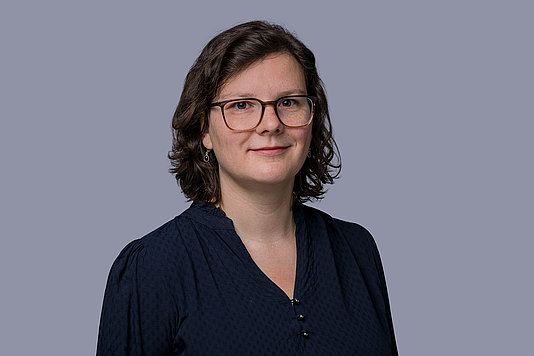
Dr Anja Klein
Postdoctoral Researcher | Project 'MultiDiv – Diversity in process: Towards multispecies assemblages for biodiversity governance'
Anja Klein is a postdoctoral researcher in the international consortium ‘MultiDiv – Diversity in process: Towards multispecies assemblages for biodiversity governance’. In this context, members of the research professorship ‘Curating Digital Objects of Cultural Knowledge and Memory’ (Tahani Nadim) at the College collaborate with researchers in France, Tunisia, Sweden and the Netherlands, aiming to develop multispecies concepts and methodologies to understand causalities and temporalities of biodiversity decline in two Mediterranean case studies.
Before that, Anja Klein worked as a research associate at Humboldt Universität zu Berlin and TU Munich in a project funded by the German Research Foundation (DFG). She studied social and cultural anthropology at Humboldt Universität zu Berlin, Freie Universität Berlin and Aix-Marseille Université (France). She obtained her PhD in 2025 with a thesis on ‘Doing difference, materiality and complexity with simulation models: An ethnography of modeling social-ecological relations in interdisciplinary sustainability research’.
Project ‘MultiDiv – Diversity in process’
Website
 ©
© eventfotograf.in
©
© eventfotograf.in
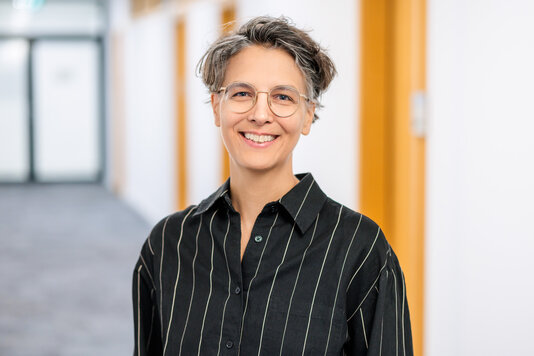
Prof. Tahani Nadim
Research Professor 'Curating Digital Objects of Cultural Knowledge and Memory'
Phone: +49 201 183 - 6560
E-mail: tahani.nadim@college-uaruhr.de
Tahani Nadim holds the research professorship ‘Curating Digital Objects of Cultural Knowledge and Memory’ at Ruhr University Bochum and the College for Social Sciences and Humanities. She has previously held a junior professorship in social and cultural anthropology at Humboldt-Universität zu Berlin in a joint appointment with the Museum für Naturkunde Berlin (MfN). At the MfN she co-lead the 'Centre for the Humanities of Nature', which she co-founded in 2018. She was spokesperson and coordinator (together with Meike Hopp, TU Berlin) of the joint research project ‘Museums and society: mapping the social’ (2020–2024). She has worked as a programme manager at the Women’s Art Library in London, an editor at Black Dog Publishing and a researcher in Goldsmiths Library (Open Access, data models and institutional repositories). She also curated exhibitions, collaborated with artists and runs the experimental research unit ‘Bureau for Troubles’.
Tahani Nadim holds a PhD in sociology of science from Goldsmiths, University of London, UK. Her interdisciplinary research has focused on the politics of data, digitisation and collections, specifically in the context of natural history and biodiversity sciences. Her recent work engages with questions of conservation and preservation, silences in/of memory cultures and the role of archives in human-environment relations.