
This workshop aims to gain a better understanding of how women experience or shape the nature of violence and victims in different cultural, social and economic contexts. Researchers and practitioners from both the Global South and the Global North will examine the intersections of gender, culture and violence; agency, context and legal issues; and aspects of resistance, resilience, coping and recovery.

Globally, women are often presented primarily as victims of gender-based violence, whether in the home, the workplace or institutions, or in the context of conflicts, wars, and banditry/terrorism, among others. Scholars and international organisations have revealed much about women as victims, while scant attention is paid to the flip side − women as perpetrators of violence. Considering both dimensions enables us to take into account the social context of perpetrating violence and becoming a victim of violence. Data shows that violence against women mostly occurs in intimate partnerships, in conflict settings, during rape, and in institutions (World Health Organisation 2025)1 . One other neglected area in scholarship is how experiences of violence, either as victims or perpetrators, vary across different contexts around the globe.
This workshop aims to gain a better understanding of how women experience or shape the nature of violence and victims in different cultural, social and economic contexts, with presentation from both the Global South and the Global North. Presentations will examine and illuminate the following issues and topics:
1 World Health Organization (2025). Violence against women prevalence estimates, 2023: global, regional and national prevalence estimates for intimate partner violence against women and non-partner sexual violence against women. World Health Organization. iris.who.int/handle/10665/383559. License: CC BY-NC-SA 3.0 IGO
Welcome and Introduction
Oludayo Tade, Senior Fellow, University of Ibadan (Nigeria)
Christine Morgenstern, Ruhr University Bochum (Germany)
‘What Led to It?’: Reported Precipitating Narratives of Intimate Partner Violence in Nigeria
John Ajibola Ogunyemi, Olabisi Onabanjo University (Nigeria)
Richard Abayomi Aborisade, Olabisi Onabanjo University (Nigeria)
Victim, Perpetrator, or Both? The Ambivalent Position of Iranian Women in the Continuum of Domestic and Institutional Violence
Mahmoud Farhadimahalli (Iran)
Breaking the Gender Stereotypes: Exploring Women as Perpetrators of Sexual Violence
Oluwatomisin Adesunmbo Adebayo, Chrisland University (Nigeria)
Lydia Isioma Chineyemba, Chrisland University (Nigeria)
Beyond Conventional Narratives: Male Acid Attack Survivors and Female Perpetrators
Shivam Raj, Banaras Hindu University (India)
Break
Gendered Victimisation of Womxn in South African Nightlife: Precarity, Spatial Risk, and Digital Absence in the Cities of Johannesburg and Cape Town
Sipho Mackenzie (South Africa)
Victimization experiences of female Tricycle drivers in Ibadan Metropolis, Nigeria
Chinedu Ernest Dinne, University of Ibadan (Nigeria)
Olaitan Tope Bada, Nigerian institute of Social and Economic Research (NISER) (Nigeria)
Lydia Titilope Okesiji, University of Ibadan (Nigeria)
Beyond Victimization and Perpetration: Situative and Biographical Factors of Women's Violence in Intimate Partnerships
Maya Middendorf, Ruhr University Bochum (Germany)
Gender-Based Violence, Institutional Failure, and the Istanbul Convention as a Normative Lever: Evidence from Germany
Kaja Deller, Frei Universität Berlin (Germany)
Lunch Break
Defrosting Silence in Unspeakable Times: Gendered Violence and Memory of Kurdish-Alevi Women in Turkey
Mehtap Tosun, Ruhr University Bochum (Germany)
‘There Are Many Bad Guys’: Indigenous Women's Narratives of Violence Caused by Organized Crime
Ana Arán Sánchez, Escuela Normal Rural “Ricardo Flores Magón” (Mexico)
Beyond Victimhood: Mothers, Nurses, and Female Caregivers in Conflict-Related Child Displacement during the Nigerian Civil War, 1967–1970
Adewale Onagbesand, University of Lagos (Nigeria)
Gendered Violence versus Gendered Fascism: Hitler's Helpers in Southern Austria during the Short 20th Century
Dagmar Wernitznig, University of Ljubljana (Slovenia)
Break
‘It’s not like any other job’: Vicarious Trauma, Vulnerability, and Responsibility in Human Rights Work in Low Income Countries
Amulya Purushothama (India)
Sreeparna Chattopadhyay, Senior Fellow, Manipal Academy of Higher Education (India)
Arti Mohan (India)
Digitafemme Praxis as Transnational and Transcultural Politics of Algorithmic Visibility in Women's Digital Resistance
Ayomiposi Adegbulugbe, University of Ibadan (Nigeria)
Victims and Perpetrators: Internalised Misogyny and the Performance of Suffering in Ayọ̀bámi Adébáyọ̀'s Stay with Me and Rimma Onoseta's How You Grow Wings
Ifeoma Cassandra Nebeife, Federal University Wukari (Nigeria)
Canonizing Cultural Constructs of Gendered Violence in The Broken Calabash and Moolaade
Esther Abimbola-Omolara Emoruwa, Adekunle Ajasin University, Akungba Akoko (Nigeria)
End of day 1
Welcome
Women as Victims and Perpetrators of Digital Violence: Female Agency in Transnational Nigerian Cybercrime Networks
Isimenmen Akhimen, Covenant University (Nigeria)
Tayo George, Covenant University (Nigeria)
Oluwaseun Emmanuel, Covenant University (Nigeria)
Sexual and Gender-Based Violence as a Structural Barrier to Women's Leadership in Community Development Associations in a Rural Southwestern Nigeria
Temitayo Omolade Adegboyega, Lead City University (Nigeria)
Victoria Folake Iyanda, Lead City University (Nigeria)
Beyond Victims: The Hidden Role of Women in Sustaining Banditry and Terrorism in Northern Nigeria
Yohanna Gulleng Daskyes, University of Jos (Nigeria)
Gender Roles and Gender Recognition in Post-Amnesty Reintegration Processes in the Niger Delta, Nigeria
Olakunle Michael Folami, Adekunle Ajasin University, Akungba Akoko (Nigeria)
Omobolaji Omolola Akande, Adekunle Ajasin University, Akungba Akoko (Nigeria)
Break
Beyond Victimhood: Women in the Context of Farmer-Herder Conflicts in Adamawa State, North-Eastern Nigeria
Saheed B. Owonikoko, Centre for Peace and Security Studies, Modibbo Adama University (Nigeria)
‘Honor Killings’ in the North Caucasus Republics: Anti-Gender Narratives in Court Verdicts
Olimpiada Usanova, Marie Jahoda Center for International Gender Studies, Ruhr University Bochum (Germany)
Neither Victim nor Perpetrator? Women Signatories with Disabilities and the Limits of Transitional Justice in Post-Agreement Colombia
Louise Alberti, Hochschulinstitut für internationale Studien und Entwicklung (IHEID) (Switzerland)
Boko Haram: Women as vanguards and victims of terrorism
Temilola A. George, Irregular Warfare Centre, National Defence College, Abuja (Nigeria)
Olubukola S. Adesina, University of Ibadan (Nigeria)
Closing
Oludayo Tade, Senior Fellow, University of Ibadan (Nigeria)
Christine Morgenstern, Ruhr University Bochum (Germany)
End of workshop
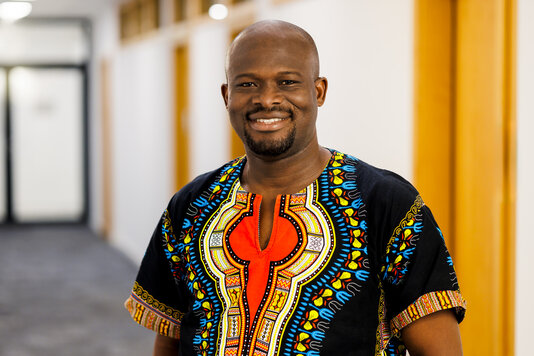
Prof. Oludayo Tade
University of Ibadan (Nigeria) | Sociology, Criminology
Oludayo Tade is a sociologist (criminology, victimology and security studies) currently teaching at the University of Ibadan (Nigeria). He is the founding president of the Nigeria Society for Criminology (NSC), Head of Communications at the Conflict Research Network West Africa (CORN) and affiliated with the African Diaspora Resource and Research Center. A former fellow at the Institute for Money, Technology and Financial Inclusion (IMTFI) at the University of California Irvine (USA) and at the Merian Institute for Advanced Studies in Africa (MIASA), Oludayo Tade’s research covers victims of crime, cybercriminality, deviance and social problems, conflict and peace studies, protests, diaspora and transnational studies.
He has received research grants from the Tertiary Education Trust Fund, Nigeria (TETFund), the Gates Foundation (USA), and the African Studies Center at the University of Michigan (USA), among others. He is a member of the Editorial Board of the International Journal of Offender Therapy and Comparative Criminology (IJOTCC) and of the Nigerian Journal of Criminology and Security Studies.

Prof. Christine Morgenstern
Ruhr University Bochum | Law, Criminology
E-mail: christine.morgenstern@rub.de

Prof. Christine Morgenstern
Ruhr University Bochum | Law, Criminology
E-mail: christine.morgenstern@rub.de
Christine Morgenstern is a lawyer and criminologist with research interests in human rights in the criminal justice system, gender aspects in criminology, and comparative criminal justice. Since 2023, she has been Professor of Criminology at the Faculty of Law of Ruhr University Bochum where she teaches criminology and criminal law. She also directs the continuing education Master’s programme in Criminology, Criminalistics, and Police Studies there. Prior to this, she was Professor for Criminal Law and Gender Studies at Freie Universität Berlin and Research Fellow at Trinity College Dublin (Ireland). Currently, her work engages with prisoner’s rights and with gender aspects of criminalisation processes.
Website
https://www.kriminologie.rub.de/index.php?option=com_content&view=article&id=4&Itemid=117