
Who gets to host, maintain, and craft the internet? This symposium focuses on the routines through which people collectively tend, inhabit and transform community network infrastructures in response to social and ecological conditions. It poses questions around energy, maintenance, communication and access, proposing that these are not abstract concepts, but embodied and lived experiences
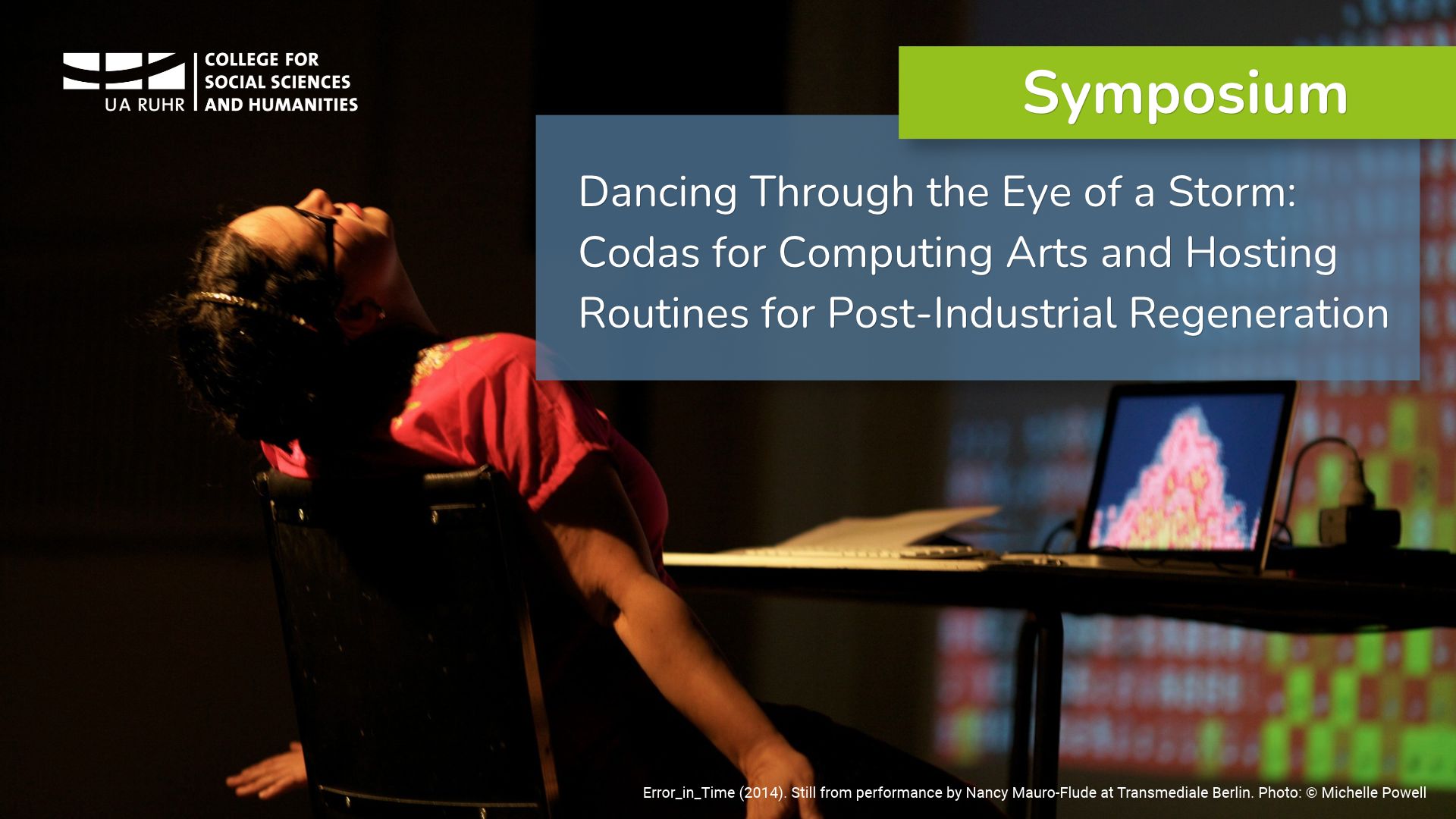
Error_in_Time (2014). Still from performance by Nancy Mauro-Flude at Transmediale Berlin. Photo: © Michelle Powell
This symposium explores the translocal ‘dance’ of computing infrastructure and maintenance that elevates the daily work of computing administration to centre stage. It unfolds in a tempestuous epoch shaped by proliferating data centres and asymmetric agency–convenience ratios, which place community-led network infrastructures in increasingly precarious conditions, co-existing with accelerating climate instability across hemispheric wildfires, Arctic and Antarctic cryospheres, and Himalayan glacial systems.
While mutual-aid web-hosting infrastructures offer techno-poetic (systerserver.net) and low-emission counterpoints (permacomputing.net) to dominant models of resource-intensive data farming and Big Tech surveillance regimes, they face cease-and-desist actions (as in the cases of the Italian hacktivist group Autistici/Inventati in 2026 or moddr_ in 2007). Researchers, designers and activists responding proactively to these conditions seek to make visible the corporeal, political and material conditions embedded within mundane computational routines: who gets to host, maintain, connect, refuse, craft the internet.
The symposium is interested in the ‘small dance’: the routines through which people collectively tend, inhabit and transform community network infrastructures in response to the social and ecological conditions in which we are embedded. It asks what it might mean to move differently within these inherited systems, and what holistic ways of computing might better support more equitable and ecologically attentive forms of post-industrial regeneration.
Welcome and Introduction
Nancy Mauro-Flude, RMIT University (Australia) & Senior Fellow, College for Social Sciences and Humanities (Germany) & Founder of ESP (Ecofeminist school for Permacomputing)
Kate Rich, Marie Sklodowska-Curie Fellow at the Alpine Community Economies Lab (Italy) & Cofounder of IBEX (Institute for Experiments with Business)
Respondent: Nancy Mauro-Flude
Presentation (title TBA)
Donna Metzlar, Systerserver.net (Netherlands)
Respondent: Estrid Sørensen, Ruhr University Bochum (Germany)
Break
Open wireless community mesh networks: Pico-peering, mutal aid, resilience and a digital glass of water for everyone
Elektra Wageguard, Freifunk.net (Germany)
Respondent: Donna Metzlar
Presentation (title TBA)
Teresa Dillon, University of Southampton (UK)
Respondent: Elektra Wageguard
Presentation (title TBA)
Selena Savić, University of Amsterdam (Netherlands)
Respondent: Audrey Samson
Institutioning Otherwise; admin after Microsoft
Audrey Samson, Goldsmiths Stanley Picker Fellow UCL (UK) & FRAUD
Respondent: Selena Savić
Respondent: Nancy Mauro-Flude
Closing reflections, future recommendations and next steps
Respondent: Estrid Sørensen, Ruhr University Bochum (Germany)
 ©
© eventfotograf.in
Dr Nancy Mauro-Flude
RMIT University (Australia) | Design Anthropology, Computing Arts
Nancy Mauro-Flude is a transdisciplinary researcher with expertise in computing arts, anthropology, and feminist science and technology studies (STS). She applies multitrophic approaches in regenerative design and making, working from Southern Oceania, Lutruwita / Tasmania, and guided by indigenous knowledge systems and experiential learning to foster eco-social cohesion. Over the past two decades, Nancy has made significant contributions to female-led web server initiatives and aesthetic engagement with open source technologies, mobile Linux, and wireless systems. She is co-founder and Secretary of the Community Network Infrastructures Special Interest Group, established with support from the Internet Society Foundation.
Nancy Mauro-Flude is a Regenerative Future Fellow at RMIT University (Australia), contributor to the Master of Design Technology and Innovation programme in RMIT’s College of Design and Social Context, and affiliated with the Post Carbon Research Centre. Her design research develops custom-built tools, cooperative situations, and participatory social sculptures that bring diverse communities together through performance, co-design, and collective inquiry. With expertise in wireless Linux systems, community networking, and free and open-source software, she explores holistic and vernacular computing, maintenance rituals, digital stewardship, and the material and social conditions of life at the edge of networked systems.
Website
 ©
© CAIS
Prof. Estrid Sørensen
Ruhr University Bochum | Anthropology of Knowledge
E-mail: estrid.sorensen@rub.de
 ©
© CAIS
Prof. Estrid Sørensen
Ruhr University Bochum | Anthropology of Knowledge
E-mail: estrid.sorensen@rub.de
Estrid Sørensen is a professor of anthropology of knowledge at Ruhr University Bochum. She has conducted research within a wide field of science and technology studies, including educational technologies, media harm discourses, cyber security, and digital methods. Most recently she has turned towards researching computing infrastructures. Her ethnographic and historical research addresses both scientific and corporate data centres as well as high-performance computing, and inquires the co-enactment of knowledge production and planetarity. She has recently coined the notion of ‘planetary scientific knowledge’ to conceptualise science as not only social and material, but as ontologically planetary.
Recent publications:
Sørensen, Estrid (2026): ‘Servers’, in: Hogan, M. / Stefan, L. / Ongweso, E. (eds.): Predictions: From Speculative Ethnography to Apocalyptic Testimony. Lancaster: Mattering Press, pp. 120–126.
Çelik, Leman / Laser, Stefan / Sørensen, Estrid / Abels, Sandra (2026): Staying with the Planet: The University That Tried to Reckon with Ecological Reality, Challenged Excessive Data Infrastructures, and Nurtured a Few Alternatives Not Planned For. Bielefeld: transcript.
Sørensen, Estrid (2026): ‘Die Als-ob, die Langsame und die Planetare Universität: Drei Modi möglicher Universitäten‘, In: Breil, P. / Sprenger, F. (eds.): Virtuelle Universität – Geistes- und gesellschaftswissenschaftliche Zugänge. Bielefeld: transcript, pp. 493–500.
Sørensen, Estrid (2025): ‘Erzählungen durch Daten: distanzierte, engagierte, responsable, kollektive und planetare‘, In: Holfelder, U. / Peball, P. W. / Schemmer, J. / Schönberger, K. (eds.): Alltage und Kultur/en der Digitalität. Wien: Selbstverlag des Vereins für Volkskunde, pp. 33–52.
Website
https://www.sowi.ruhr-uni-bochum.de/cupak/team/sorensen.html.en