
South Asian countries have encountered many decades of violence stemming from ethnic insurgencies, religion-based extremism, ideology-driven hostilities and territorial disputes. While violent conflicts have long characterised the region, the early 1980s witnessed a significant escalation, driven by the emergence and intensification of several critical conflicts: the 1983 anti-Tamil pogroms in Sri Lanka igniting decades of ethnic conflict, the prolonged armed conflict between Bangladeshi forces and the Shanti Bahini in the Chittagong Hill Tracts beginning in the early 1980s, the insurgent violence in India’s Jammu and Kashmir during the 1990s, and the Taliban’s enduring presence in Afghanistan. This constellation of conflicts has generated significant civilian casualties, enforced disappearances, incidents of rape and torture, and psychological trauma. Consequently, many families were internally displaced, while some managed to seek refuge in European countries. For families unable to leave their homelands, sending their children abroad through transnational adoption emerged as a means of securing their survival.
The children sent for transnational adoption, mostly aged between six and 16 years, carried cultural memories of their lives in the countries of origin. In the host countries, they underwent a complex journey of integration into new cultural contexts and identities. This research project seeks to investigate how adoptees negotiate memories of violence, associated trauma and cultural memories with the new cultural realities of the host countries – including language, kinship, food practices, and lifestyle norms. This study also seeks to explore the role of adoptive parents and host country policies in shaping transition and reconstructing identities.
As adoptees grow up, some undertake journeys to their countries of origin in search of biological families and cultural origins. This project aims to analyse the mechanisms through which they attempt to re-engage with familial and cultural networks, both in their homelands and host country contexts. It also seeks to explore whether such efforts lead to a revisiting of their identities. This study adopts a multi-sited, discursive approach and employs qualitative methodology. Due to time constraints, the fieldwork focuses on Sri Lankan, Indian, Bangladeshi and Afghan adoptees residing in Germany and France.
 ©
© eventfotograf.in
©
© eventfotograf.in
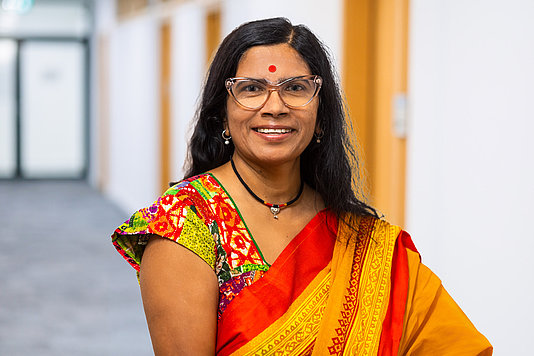
Prof. Zobaida Nasreen
University of Dhaka (Bangladesh) | Anthropology
Zobaida Nasreen is Professor of Anthropology at the University of Dhaka (Bangladesh) and was a Fulbright Scholar in the anthropology department of Rice University, USA (2018–2019). She received her PhD in social anthropology from Durham University (UK) as a commonwealth scholar. After obtaining a Master’s degree in anthropology from Jahangirnagar University (Bangladesh), she completed her Master’s degree in development studies at Hiroshima University (Japan) on a Japanese government scholarship. Her doctoral research at Durham University was on ‘The Indigeneity Question: State Violence, Forced Displacement and Women’s Narratives in the Chittagong Hill Tracts of Bangladesh’ and her areas of interest include anthropology of violence, forced displacement, sexuality and masculinity, social memory, social movements, as well as indigeneity and identity politics.
Zobaida Nasreen has co-edited Political Violence in South Asia with Ali Riaz and Fahmida Zaman (Routledge 2018) and authored 12 books including Stories of Gender Diversity (2019), Anthropological Explorations (2018), Women’s Journey against All Odds (2013), Poverty and Health: Women in Tanneries (2008), Martyred Women of the Liberation War (2008), Hajong Women in the Labour Market (2008), Indigenous Women in the Liberation War (2008), and The Marginalisation Discourse of Ethnic People in the Northern Part of Bangladesh (2006, with Mesbah Kamal and Eshani Chakraborty). She has published in various local and international journals and has worked as a consultant for several national and international organisations, including United States Agency for International Development (USAID), International Labour Organization (ILO), Oxfam Great Britain, DASCOH foundation, United Nations Development Programme (UNDP), United Nations Population Fund (UNFPA), ActionAid, and Bangladesh Rural Advancement Committee (BRAC). She has also been writing columns since 1996 for a number of daily newspapers and provides expert opinion on current social and political issues on BBC Bangla Service and Voice of America (VOA) Bangla.
Website

Prof. Christian Gudehus
Ruhr University Bochum | Social Science, Social and Cultural Psychology
E-mail: christian.gudehus@rub.de

Prof. Christian Gudehus
Ruhr University Bochum | Social Science, Social and Cultural Psychology
E-mail: christian.gudehus@rub.de
Christian Gudehus is a social scientist with a particular interest in social and cultural psychology. Together with Pradeep Chakkarath, he has been publishing the journal HARM as an open-access publication since January 2022. He also founded the journal Trauma Kultur Gesellschaft (trauma culture society) together with colleagues from the clinical field and the social sciences and humanities. He is also a permanent fellow at the Hans Kilian and Lotte Köhler Centre (KKC) for Social and Cultural Psychology and Historical Anthropology located at Ruhr University Bochum, where he teaches and researches with a focus on collective violence, its conditions, its events and its consequences.
Website
https://www.sowi.ruhr-uni-bochum.de/lehre/sopsan/gudehus.html.en