
This research project examines how sustainable development is being reframed through the lens of shifting geopolitical dynamics, with a specific focus on cooperation between Europe and Africa. While the Sustainable Development Goals (SDGs) as part of the United Nations’ 2030 Agenda for Sustainable Development were launched during a period of international consensus, the contemporary geopolitical context, marked by rising nationalism, energy insecurity, regional conflicts, and weakened multilateralism, now threatens their coherence and long-term viability. Nowhere is this tension more visible than in Africa-Europe relations, where strategic European Union (EU) policies such as the European Green Deal and the Carbon Border Adjustment Mechanism (CBAM) intertwine sustainability objectives with political and economic interests. These initiatives, while advancing green transitions, also risk constraining African policy autonomy, introducing trade-related pressures, and complicating development finance.
This project addresses a critical gap in current scholarship, which often treats sustainable development as an apolitical process and underestimates the role of geopolitical forces in shaping cooperation frameworks. It analyses how sustainability discourses and development strategies are being reshaped under the influence of EU policy shifts and assesses how selected African countries – South Africa, Ghana, and Kenya – are responding to these changes. Using a qualitative design that combines document analysis and expert interviews, the research will explore evolving narratives, power dynamics, and institutional responses.
The study will contribute to new insights to the interdisciplinary field of sustainability and geopolitics and aims to inform more equitable, adaptive, and context-sensitive development cooperation frameworks. Planned outputs include a peer-reviewed article, a stakeholder workshop, and a policy brief with recommendations for enhancing the resilience and inclusiveness of sustainability strategies in a multipolar world.
 ©
© eventfotograf.in
©
© eventfotograf.in
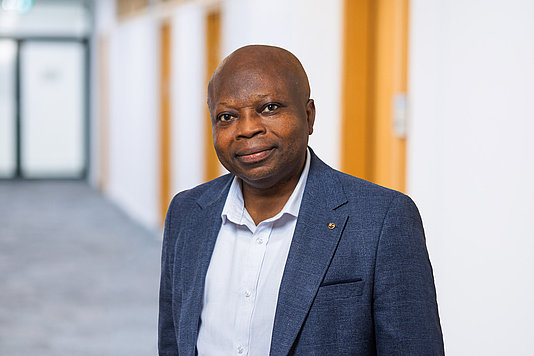
Prof. Albert Ahenkan
University of Ghana (Ghana) | Sustainable Development
E-mail: albert.ahenkan@college-uaruhr.de
Albert Ahenkan is Professor of Sustainable Development at the University of Ghana Business School and Head of the Department of Public Administration. He is an internationally recognised expert in sustainable development; sustainable finance, green economy, climate policy, environmental, social and corporate governance (ESG), circular economy, and green finance. His work focuses on strengthening public policies, institutions, and governance systems that advance sustainable development and climate resilience. With over 15 years of international consulting experience, he has served as international consultant and technical advisor to governments and organisations including the African Union Development Agency AUDA-NEPAD, United Nations Development Programme (UNDP), World Bank, International Fonds for Agricultural Development (IFAD), Deutsche Gesellschaft für Internationale Zusammenarbeit (GIZ), United Nations Institute for Training and Research (UNITAR), United States Agency for International Development (USAID), and C40 Cities Climate Leadership Group. He has led major assignments on climate policy, agrifood systems, sustainable finance, ESG, climate finance, and public sector reform across Africa. Albert Ahenkan has authored more than 100 peer-reviewed publications and is widely recognised for integrating sustainability into governance reforms.
Website
 ©
© MIASA
©
© MIASA
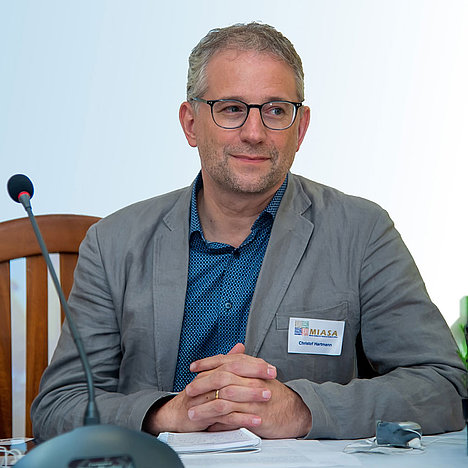
Prof. Christof Hartmann
University of Duisburg-Essen | Political Sciences
E-mail: christof.hartmann@uni-due.de
 ©
© MIASA
©
© MIASA
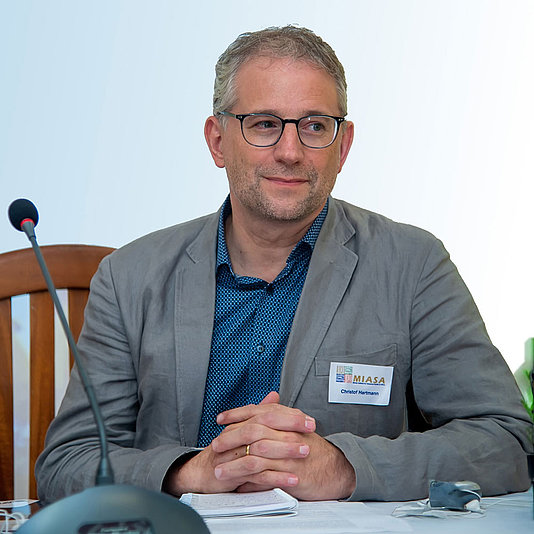
Prof. Christof Hartmann
University of Duisburg-Essen | Political Sciences
E-mail: christof.hartmann@uni-due.de
Christof Hartmann is Professor of International Relations and African Politics at the Institute of Political Science, of the University of Duisburg-Essen and Director of the Institute for Development and Peace (INEF). He is also corresponding member of the Institute of Development Research and Development Policy at Ruhr-University Bochum, where he worked before joining the University of Duisburg-Essen in 2006. He was also a Senior Guest Lecturer at the University of the Western Cape, South Africa (2002–2006) and a Senior Fellow at the Merian Institute for Advances Studies in Africa in Accra, Ghana (2023).
His research interests focus on processes of institutional change in African countries, regional cooperation in Africa with a focus on West Africa, Africa’s development and Africa’s relations with external actors. He has published extensively on governance, development, democracy, authoritarianism and regionalism in Africa. His recent books include China’s New Role in African Politics: From Non-Intervention towards Stabilization (Routledge 2020) and African Non-Military Conflict Intervention Practices (Routledge 2026).
Website