
Interview with Sule Emmanuel Egya
 ©
eventfotograf
©
eventfotograf
The interdisciplinary research field of environmental humanities examines the complex relationships between humans and their environment from a humanities perspective. It is one of the focus areas of Sule Egya, who took up the research professorship ‘Public Social Sciences and Humanities: Key Societal Debates’ at the College for Social Sciences and Humanities in April 2026. In this interview, he explains how environmental issues are connected with colonial history and global imbalances. He also elucidates how he intends to engage the public in debates about current societal issues, such as environmental problems and migration.
 ©
eventfotograf
©
eventfotograf
My main research interests are African literary and cultural productions, environmental humanities, decolonial studies, indigenous studies, and migration studies. As a writer of fiction and poetry, I am also interested in creative imagination and imaginative criticism. Some of the questions I seek to answer in the context of these fields are: in what ways do literary and cultural productions in Africa, and in other parts of the Global South, represent the fate of humans and non-humans in marginalised, economically weak communities? How might indigenous knowledges and practices, which have been colonially repressed, teach us some lessons about the ways we relate with our earth in the present time? How might environments, both physical and non-physical, enhance (or undermine) our understanding of the conflicts that arise from migration? And what might be the role of creative imagination in apprehending the social and environmental conflicts that afflict modern life?
Environmental humanities applies the research protocols of the humanities to environmental issues. Investigating the environment was traditionally a domain of the natural sciences. Scholars in the environmental humanities seek to understand the complex relationships between the environment and human beings – from the vantage points of literary and cultural studies, history, philosophy, religious studies, economics, educational studies, or sociology. For instance, they look at how pollution and climate change affect individuals and societies. Environmental humanities also takes into account how industrialisation and economic expansion are rooted in exploiting the environment, often coinciding with the degradation of natural resources and dispossession of the local population. Moreover, the conception of the humanities is expanded to include non-human beings such as animals.
"I am interested in accommodating bodies of knowledge from different parts of the world, and in facilitating approaches to making these knowledges public. This includes fostering sustained dialogue between the Global South and the Global North."
The central aim of my research is the promotion of a healthier planet and a world with less colonial grip where different voices, systems, and epistemologies – privileged or underprivileged – are allowed to dialogue, converse, and interact to build a rich and robust community of humans and other kinds of beings. This aim will generally frame my research questions. As such, I am interested in accommodating bodies of knowledge from different parts of the world, and in facilitating approaches to making these knowledges public. This includes fostering sustained dialogue between the Global South and the Global North. Another goal is to create spaces for thinkers, scholars, writers, artists, and other kinds of cultural producers of different backgrounds to interact with the public. I have interest in the ways in which public-facing conversations can promote more pluralist societies where people are allowed to freely engage in debates about issues that are of utmost concern to them.
My approach to realising the public-facing dimension of this professorship includes various formats. I would like to organise a periodical event where renowned thinkers, scholars, writers, artists, filmmakers, musicians, etc from different backgrounds engage in dialogue with the public in the Ruhr region. This will pave the way for a cross-cultural, cross-disciplinary, and cross-genre conversation for (re)shaping our planetary and decolonial futures. By that I mean a utopian concept, imagining a world in balance that is free of discrimination and colonialism. Furthermore, I intend to collaborate with cultural organisations, theatre groups, activist groups, etc to curate boundary-breaking conversations. This can also involve tying in with cultural festivals in the Ruhr region for a broader scope of internationalisation. Formats could include roundtable discussions, book chats, film screenings, and performances. I also intend to establish a blog that will showcase the activities of the professorship in addition to providing an outlet for writers and scholars across the world to publish creative works, short public-facing essays, and artworks.
I am attentive to issues of climate, environment, extraction, migration, indigenous systems, decoloniality, gender and sexuality, and imaginative expression to the extent that they promote democratic and pluralist societies. My priority for now would be environment, migration, and indigenous epistemologies. The latter refers to knowledge systems of indigenous communities, looking at how indigenous people establish relationships with the environment and deal with environmental issues.
One example of a relevant research context is that extraction is tied to the current global energy transition because rare earths are needed for electronics. Moreover, environmental change is connected to migration movements, for instance as some regions become uninhabitable.
"The case for nearly all the societies of Africa is that the ecological is profoundly entangled with the social because advocating for environmental justice implies fighting for social justice. One aspect of this is that the effects of climate change disproportionately affect the Global South."
My research over the years has mainly focused on African societies, has sought to explain the interconnectedness of ecology and society, driven by what I have, at different contexts, described as socio-ecological visions (i.e., the concern with the fate of both humans and non-humans), and eco-literary militancy (i.e., the use of literary writing to aggressively confront extractive capitalism). The case for nearly all the societies of Africa is that the ecological is profoundly entangled with the social because advocating for environmental justice implies fighting for social justice. One aspect of this is that the effects of climate change disproportionately affect the Global South. These effects go along with impoverishment and economic dispossession, as people’s means of subsistence are being destroyed. This is how environmental issues are connected with social welfare. Within the context of what has been widely termed as the ‘environmentalism of the poor’, my work has sought to address the plight of the poor locals who are dispossessed, displaced, and dehumanised. In this context, the advocacy is not only to better the condition of non-human beings, but also of the human beings who must first survive before they can take care of their earth.
It absolutely does. Sometimes when I am writing an academic essay, my style slips into the imaginative domain. Ordinarily, a scholarly writing is not meant to be poetic. But I sometimes find my style waxing poetic and then I have to call myself to order. But I also believe – and I teach my students – that a good literary student or scholar, or an exciting academic essay, needs to be imaginatively critical and critically imaginative. For me, creative writing and literary scholarship are interwoven since I use both of them to achieve the same aim. Both are complimentary means through which I present debates about our immediate society and our planet. I will organise a periodic creative writing workshop that is open to the public with the intent of allowing those who are not members of academic institutions to exercise their imaginations.
Literature and arts are parts of an imaginative domain that allow thinkers to create alternatives to existing social structures. Writers and artists have the ‘license’ to deploy fictional and aesthetic means to envision more humane, rational, and open societies. The majority of this special category of people is on the side of human and non-human rights, on the side of the downtrodden, imagining the moral high grounds of existence. Writers and artists are also endowed with the capability to interrogate power structures.
"Trained as a literary scholar, I have been concerned with the environmental imagination that shapes literary and cultural productions in Africa. Beyond that, I have also focused on the role of literature and artistic productions in confronting environmental destructions arising from extractive activities across the African continent."
I am fascinated by the excellent facilities for research, in terms of funding and physical amenities. The multicultural and multidisciplinary atmosphere at the College is of great interest to me. I take it for granted that I will enjoy a considerable degree of academic freedom that will allow me to engage in the research of my choice. Above all, the idea of public social sciences and humanities – that we can create opportunities to engage the public meaningfully – is something that ties in well with my life-long ambition as a scholar, writer, and cultural activist.
I have identified a number of research units that I plan to collaborate with in the course of my research, including the Institute for Advanced Studies in the Humanities Essen (KWI), the Institute for Development and Peace at the University of Duisburg-Essen, and the Institute for Social Movements at Ruhr University Bochum. I am also involved with the Joint Institute for Conflict Analysis, Conflict Regulation and Democratic Education (CONCREDE) at the Universities of Duisburg-Essen and Münster, particularly the research collectives ‘Agonistic Plurality’ and ‘Cultures of Compromise’.
Critical analysis and contextualisation of contemporary key societal debates about pressing social and environmental issues are the core concern of this professorship. Bridging the social sciences and the humanities, it analyses cultural, socio-political, and environmental phenomena and centres major fault lines of public conflicts. The professorship pursues a dual public orientation by responding to public debates and communicating with a wider audience beyond academia.

I have a wide national and international network of researchers and institutions some of which I have collaborated with, including the University of Warwick (UK), Yale University (USA), University of Hyderabad (India), Environmental Science Center (University of Augsburg), University of Oldenburg, the Rachel Carson Center for Society and Environment (University of Munich), Multidisciplinary Environmental Studies in the Humanities (University of Cologne) and IBB University (Nigeria). I would like to continue these collaborations in the aspects of joint research, workshops conferences, and visits. For instance, I will be organising international conferences that will address the nexus of global energy and climate change.
Trained as a literary scholar, I have been concerned with the environmental imagination that shapes literary and cultural productions in Africa. Beyond that, I have also focused on the role of literature and artistic productions in confronting environmental destructions arising from extractive activities across the African continent. The motivation for me is to reach marginalised human and non-human communities and take them as a critical point of thinking about our planet earth ‘from below’. In a nutshell, I’m driven by the strong impulse to confront hierarchies in knowledge systems, global structures of domination, and systems that frame humans as superior to other beings.
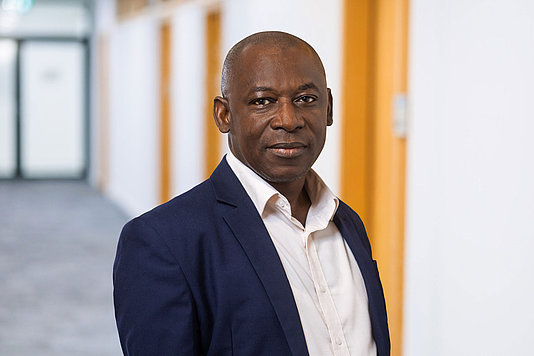
Prof. Sule Emmanuel Egya
Research Professor 'Public Social Sciences and Humanities: Key Societal Debates'
Phone: +49 201 183 65 71
E-mail: sule.egya@college-uaruhr.de
Sule Emmanuel Egya holds the research professorship ‘Public Social Sciences and Humanities: Key Societal Debates’ at the College for Social Sciences and Humanities and the University of Duisburg-Essen as of April 2026. Prior to his appointment, he was Professor of African Literature and Environmental Humanities at Ibrahim Badamasi Babangida University, Nigeria (2014–2026). During that time, he spent several research visits in Germany, including at Humboldt-Universität zu Berlin, LMU Munich and the College for Social Sciences and Humanities. Sule Egya’s main research interests have been about the response of literature and other cultural artforms to social, political, and environmental conflicts. He has published numerous articles, monographs, and edited volumes, including Nation, Power and Dissidence in Third Nigerian Poetry in English (2019), Power and Resistance: Literature, Regime, and the National Imaginary (2019), and Nature, Environment and Activism in Nigerian Literature (2020). He is also an award-winning poet and novelist. He is the author of, among others, Sterile Sky (2012; Commonwealth Book Prize), Makwala (2020; ANA Prose Prize), and What the Sea Told Me (2009; winner, ANA Poetry Prize).
 Back to FEATURES