
Can cosmopolitan thought move beyond binary oppositions without erasing difference or reproducing the very hierarchies it seeks to overcome? This interdisciplinary workshop examines how we might reconceptualise human identities, relationships, and global belonging beyond established binaries, opening up new possibilities for a genuinely global cosmopolitanism.
From ancient philosophical reflections on shared humanity to (post-)modern debates on universalism, human difference, and global belonging, cosmopolitanism has sought to imagine forms of solidarity and obligation beyond national, cultural, and civilisational boundaries. Yet competing strands of cosmopolitan thought, despite their different intellectual and political orientations, often retain binary assumptions reflected in distinctions such as universal/particular, global/local, self/other, citizen/non-citizen, and West/non-West. Such binaries frame difference through oppositions, often privileging one term over the other and reproducing the hierarchies, exclusions, and divisions that cosmopolitanism seeks to overcome. This points to a deeper challenge: whether cosmopolitan thought can reconfigure the very terms through which human identities, relationships, and the wider global community are conceptualised.
This workshop takes up this challenge through three interconnected lines of enquiry: expanding the intellectual horizons of cosmopolitanism, rethinking the grounds of cosmopolitan belonging, and reconstructing the conceptual foundations of cosmopolitan thought through alternative understandings of difference and relationality. It considers how these complementary trajectories might open up new ways of conceptualising global community. Bringing together scholars working across philosophy, political science, International Relations, anthropology, law, political economy, history, and sociology, the workshop fosters dialogue across disciplinary and theoretical perspectives without presupposing a common position or a predetermined solution.
Ultimately, the workshop seeks to advance a critical discussion of the possibilities and limits of a post-binary reorientation of cosmopolitan thought. How might unity and difference be understood in relation to one another without reducing either to the other? What conceptual, methodological, and practical challenges would such a reorientation entail? And what intellectual resources might help us imagine and enact a new global cosmopolitanism?
The organisers invite researchers from various disciplines to participate and actively engage in the discussions.
Welcome and Introduction
Deepshikha Shahi, O.P. Jindal Global University (India) & Senior Fellow, College for Social Sciences and Humanities, University Alliance Ruhr
Chair and Discussant: Navnita Chadha Behera, University of Delhi (India)
13:40
Provincializing Cosmopolitanism: Lessons about Pluralism from the (Post-)Ottoman World
Nora Fisher-Onar, University of San Francisco (USA)
Break
15:00
Critical Cosmopolitanism and Intercultural Dialogue
Cristina Foroni Consani, Federal University of Paraná (Brazil)
16:00
Intersubjective Becoming: Dialectics, Non-Duality, and the Possibilities of Global Cosmopolitanism
Shannon Brincat, University of the Sunshine Coast (Australia)
End of day 1
Chair and Discussant: Andreas Niederberger, University of Duisburg-Essen, (Germany)
09:00
Between Particular Belonging and Universal Solidarity: Cosmopolitanism as Friendship
Simon Polinder, Utrecht University (Netherlands)
10:00
The Oceanic Self and Transnational Cosmopolitanism: Exile, Care and Rescue
Sergei Akopov, Sciences Po (France)
Coffee break
11:15
Complicit Cosmopolitanism: Strategizing Home into a Stranger
Chih-yu Shih, National Taiwan University (Taiwan)
Lunch break
Chair and Discussant: Günther Hellmann, Goethe University Frankfurt (Germany)
13:15
The Making of the Global: Entangled Histories Beyond Civilisational Binaries
John M. Hobson, University of Sheffield (UK)
14:15
A World Without Outsiders? Tianxiaism and the Reimagining of Global Cosmopolitanism
Changkun Hou, National Taiwan University (Taiwan)
Coffee break
15:30
Things or Effects? A Relational Reading of Colonial Difference and Post-Binary Global Cosmopolitanism
Kosuke Shimizu, Ryukoku University (Japan)
Closing Reflections and Future Directions
 ©
© eventfotograf.in
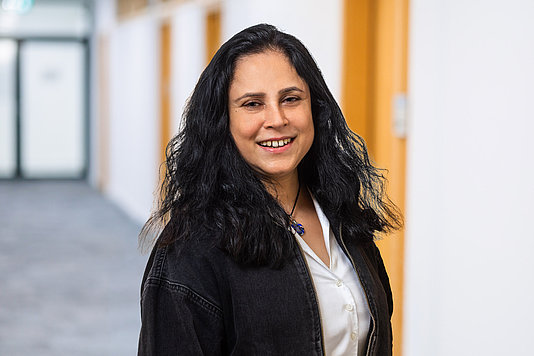
Prof. Deepshikha Shahi
O.P. Jindal Global University (India) | Political Science, International Relations
Deepshikha Shahi is Professor of International Relations at the O. P. Jindal Global University (India). She pursued research at the University of Rostock as a Humboldt Research Fellow (2024–2026) and at the Centre for Global Cooperation Research, University of Duisburg-Essen, as a postdoctoral fellow (2017–2018). She has served as Professor of Politics and International Relations at the University of Delhi (India).
Through engagements with Indic, Islamic, Chinese, Japanese, African, and pre-Socratic Greek thought, she has developed approaches that contribute to ongoing efforts to broaden the intellectual foundations of International Relations. Her publications include the monographs Advaita as a Global International Relations Theory (2018), Kautilya and Non-Western IR Theory (2019), and Global IR Research Programme: The Futuristic Foundation of One and Many (2023). She has edited Sufism: A Theoretical Intervention in Global International Relations (2020) and Nondualism in International Relations: A Methodological Reconstruction Beyond Binaries (2026). Her work has appeared in journals such as European Journal of International Relations, International Theory, Millennium: Journal of International Studies, Cambridge Review of International Affairs, and Third World Quarterly.
Website
https://jgu.edu.in/jsia/research/centre-for-the-study-of-global-international-relations-csgir#rp-07
 ©
© Niederberger
Prof. Andreas Niederberger
University of Duisburg-Essen | Political, Legal and Social Philosophy
E-mail: andreas.niederberger@uni-due.de
 ©
© Niederberger
Prof. Andreas Niederberger
University of Duisburg-Essen | Political, Legal and Social Philosophy
E-mail: andreas.niederberger@uni-due.de
Andreas Niederberger is Professor of Political, Legal and Social Philosophy at the University of Duisburg-Essen. He was a visiting professor at Saint Louis University and Northwestern University (both USA), the University of Osaka (Japan), and LUISS in Rome (Italy). His research focuses on the foundations of democracy and law, as well as questions of human rights, global justice and legitimacy, particularly in relation to war, migration, climate change and property regimes. He has led, and continues to lead, numerous research projects, including the EU Horizon 2020 research project ‘Norms and Values in the European Migration and Refugee Crisis’ (NoVaMigra), which examined whether and how the recent influx of refugees to Europe had affected European values and, more broadly, democratic institutions and procedures. Since 2021, he has been Deputy Chair of the Centre for Global Cooperation Research in Duisburg. Recent publications are Philosophie der Menschenrechte (Bielefeld: utb 2025), Handbook of Migration Ethics (ed. with U. Okeja and J. Gördemann, Cham: Springer 2025), and Cosmopolitan Norms and European Values. Ethical Perspectives on Europe’s Refugee Policy (ed. with M. Göbel, New York, London: Routledge 2024).
Website
https://www.uni-due.de/philosophie/politischephilosophie/niederberger