
In the early 20th century, major German-Jewish thinkers converged upon Daoism as a source for capital-critical alternatives to state power. Ideas from China had circulated in Germanophone lands since the 18th century, facilitated by colonial-missionary networks. Yet the German-Jewish reception was singular and pivotal to the emergence of the Frankfurt School of Critical Theory. Building on new archival research, the project focuses on one concept broadly associated with Daoism – wu wei or 'non-action' – and its transformation by Martin Buber, Franz Kafka, Franz Rosenzweig, and Walter Benjamin into variations of non-participation in the capitalist ethic, non-conformity with the Christian-colonial project, and non-absorption into the racialisation of work prevalent in theories of political-economic activity even today. Reconstructing their response to a China at the intersection of colonialism, capitalism, and revolution, the project seeks to reconfigure Critical Theory's resources for a world not solely organised around Global-North paradigms of action and knowledge. Together with her tandem partner Astrid Deuber-Mankowsky (Ruhr University Bochum), Julia Ng will develop several offshoot studies from her book project as part of an effort to lay the foundations for a new interdisciplinary research area on the intersections of German-Jewish thought, Critical Theory, and the Global South.
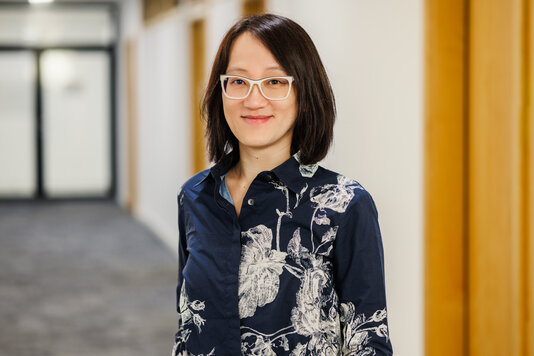
Prof. Julia Ng
Goldsmiths, University of London (UK) | History of Philosophy, German and Comparative Literature
E-mail: julia.ng@college-uaruhr.de
Julia Ng is Reader in Critical Theory and Founding Director of the Centre for Philosophy and Critical Thought at Goldsmiths, University of London (UK). Her work has explored the links between modern mathematics and political thought, modern German-Jewish philosophy, and theories of history and language in the 20th century, particularly in the work of Walter Benjamin.
Julia Ng's investigation of the history of Critical Theory is based principally on archival research: as seen, for instance, in her co-edition of Walter Benjamin, Gershom Scholem, and the Marburg School: Special Issue of the Modern Language Notes 127.3 (2012), and (with Peter Fenves) of Walter Benjamin's Toward the Critique of Violence and associated fragments (2021), which also contains her new translation and critical annotations on Benjamin's essay. She is also the co-editor of Werner Hamacher's writings on Friedrich Hölderlin (2020) and contributes more broadly to literary and Critical Theory with work on Derrida, Agamben, Kant, Descartes, Shakespeare, Sappho, Sterne, Kraus, Baudelaire, and figures of reversibility, undecidability, singularity, and the philosophical archive.
Julia Ng is currently completing a book on Daoism and capitalism based around Benjamin’s and Weber’s respective images of China ancient and modern, which has received support from a British Academy Mid-Career Fellowship, the Leverhulme Trust, the Center for Jewish History (New York City, USA), and the British Society for the History of Philosophy.
Website
https://www.gold.ac.uk/music-english-theatre/people/ng-julia/
 ©
© Damian Gorczany
©
© Damian Gorczany
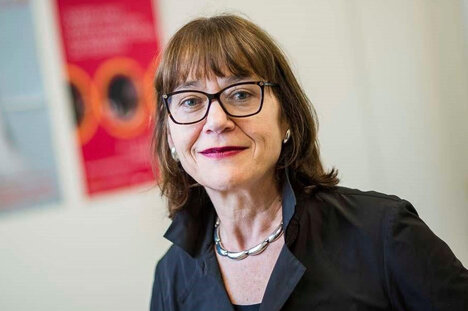
Prof. Astrid Deuber-Mankowsky
Ruhr-University Bochum | Media Studies / Gender Studies
E-mail: astrid.deuber-mankowsky@rub.de
 ©
© Damian Gorczany
©
© Damian Gorczany
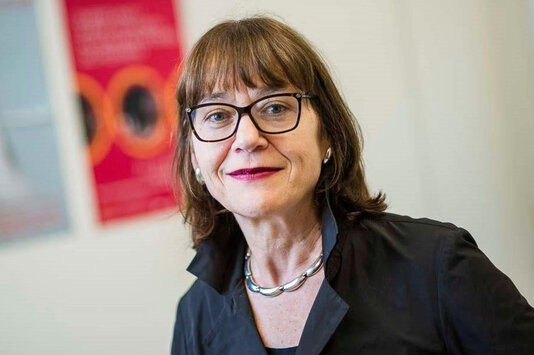
Prof. Astrid Deuber-Mankowsky
Ruhr-University Bochum | Media Studies / Gender Studies
E-mail: astrid.deuber-mankowsky@rub.de
Astrid Deuber-Mankowsky is Professor emerita of Media Studies and Gender Studies at Ruhr University Bochum. Before joining Ruhr University Bochum, she taught at the Institut für Kulturwissenschaft at Humboldt-Universität Berlin from 1996 to 2004. She is co-founder and was editor of the journal Die Philosophin. Forum für feministische Theorie und Philosophie from 1990 to 2004. She was a visiting scholar at UC Berkeley, USA (2007), visiting professor at the Centre d’études du vivant, Université Paris VII – Diderot, France (2010), senior fellow at the Internationales Kolleg für Kulturtechnikforschung und Medienphilosophie (IKKM) of the Bauhaus-Universität Weimar, Germany (2013), and Max Kade Professor at Columbia University (2012 and 2017), UC Berkeley (2022), Northwestern University (2023), Johns Hopkins University (2024) and Yale University, USA (2024). She is associate member of the Berlin Institute for Cultural Inquiry (ICI), and spokesperson of the scientific board of the Deutsches Historisches Museum Berlin. Her research focuses on topics in critical, feminist and queer theory, media philosophy and epistemology, temporality and media aesthetics, media anthropology and theories of play, as well as Jewish philosophy.
Website