
One of the dimensions of the ‘Third Mission’ of academic institutions is collaboration between universities and companies. Based on the examples of Germany and Mozambique, this workshop reflects on and discusses patterns of collaboration in the Global North and the Global South, exploring similarities and differences.
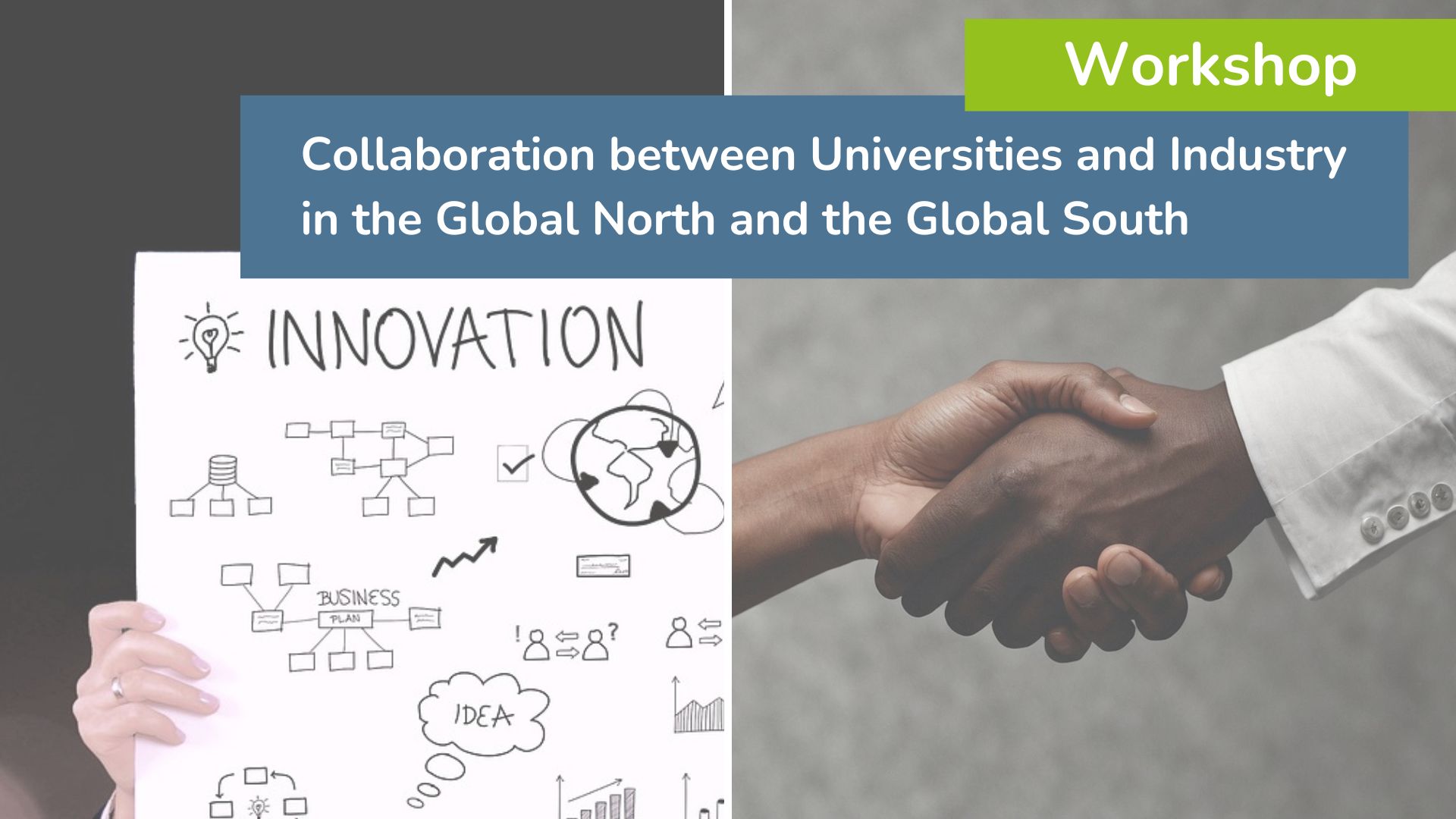
The growing reliance on knowledge by the knowledge economy has increased the relevance of higher-education institutions in society and the social sector. Higher education institutions are experiencing increasing pressure to add, besides teaching and research – or even to shift to – a ‘Third Mission’ of contributing to the social, cultural, and economic development of the surrounding regions, by transferring knowledge to a diverse array of external social and economic stakeholders.
One of the key dimensions of the Third Mission are university-industry linkages or collaboration. A knowledge-based economy also strongly relies on partnerships between universities and companies. Companies approach universities, particularly research-intensive universities, to get innovations to sustain their competitiveness. Universities, facing financial constraints, ‘commodify’ their knowledge to serve companies, in what has become known as ‘academic capitalism’ or entrepreneurial universities. Governments support partnerships, through legislations and funding policies. However, the patterns of collaborations display some similarities and differences among countries from the Global North and the Global South.
Drawing from the examples of Germany and Mozambique, the objective of this workshop is to gather together people from different academic and non-academic institutions to reflect on and discuss the patterns of collaboration in the Global North and the Global South. The discussions will address the following questions:
Participants will address these questions and cover some or all items indicated below:
Registration
Introduction
Nelson Zavale, Eduardo Mondlane University (Mozambique) & College for Social Sciences and Humanities
Challenges and opportunities in knowledge transfer between universities and industry, and the special characteristics of the German higher education system
Uwe Wilkesmann, TU Dortmund University, Centre for Higher Education (zhb) (Germany)
Patterns of collaboration from the perspective of universities
Roland Kriedel, Center for Entrepreneurship and Transfer, TU Dortmund University (Germany)
Patrick Krenz, GUIDE Centre for Start-up and Innopreneurship, University of Duisburg-Essen (Germany)
Patterns of collaboration from the perspective of industry
Gero Stenke, Stifterverband für die Deutsche Wissenschaft (Germany)
[association of German foundations promoting science and research]
Coffee break
Patterns of collaboration from the perspective of universities and industry in the Global South
Nelson Zavale, Eduardo Mondlane University (Mozambique) & College for Social Sciences and Humanities
Fernando dos Santos, former Director of the African Regional Intellectual Property Organization (Zimbabwe) and former Director of the Institute for Industrial Property Mozambique
Lunch break
Panel discussion
Wrap-Up
Nelson Zavale & Uwe Wilkesmann

Prof. Nelson Casimiro Zavale
Eduardo Mondlane University (Mozambique) | Education, Higher Education and Science Studies
Nelson Casimiro Zavale is currently Associate Professor at Eduardo Mondlane University (UEM) in Maputo, Mozambique, and an affiliate of the African Academy of Sciences. Previously, he was a senior research fellow at RWTH Aachen University, Germany (2022–2024), a Fulbright visiting scholar at the University of California, Berkeley, USA (2021–2022), a Humboldt Research Fellow at the International Center for Higher Education Research INCHER, University of Kassel, Germany (2018–2021) and a Swiss Government Excellence postdoctoral fellow (2015–2016) at the University of Basel, Switzerland. He has also held different management positions at UEM, among others as Deputy Dean for Research and Extension.
Nelson Casimiro Zavale’s research focuses on questioning existing assumptions in Africa (and the Global South) about the contribution of higher education, science, technology and innovation to socio-economic development. His work appeared in several peer-reviewed journals, including Higher Education, Scientometrics, Science and Public Policy, International Journal of Educational Development, and Quality in Higher Education. His latest book University Societal Engagement in African Contexts: Benefits, Drivers and Constraints was published by Routledge in 2025.

Prof. Uwe Wilkesmann
TU Dortmund University, Centre for Higher Education (zhb) | Organisation Studies and Management of Continuing Education
E-mail: uwe.wilkesmann@tu-dortmund.de

Prof. Uwe Wilkesmann
TU Dortmund University, Centre for Higher Education (zhb) | Organisation Studies and Management of Continuing Education
E-mail: uwe.wilkesmann@tu-dortmund.de
Uwe Wilkesmann is Director of the Centre for Higher Education (zhb) at TU Dortmund University and professor for Organisation Studies and Management of Continuing Education. He teaches as a co-opted professor at the Department of Social Sciences. His research focusses on higher education, knowledge-intensive organisations, and organisational sociology.
Research profile (TU Dortmund University): https://ow.zhb.tu-dortmund.de/en/research/profile.
Website
https://ow.zhb.tu-dortmund.de/en/professorship/team/prof-dr-uwe-wilkesmann