
 ©
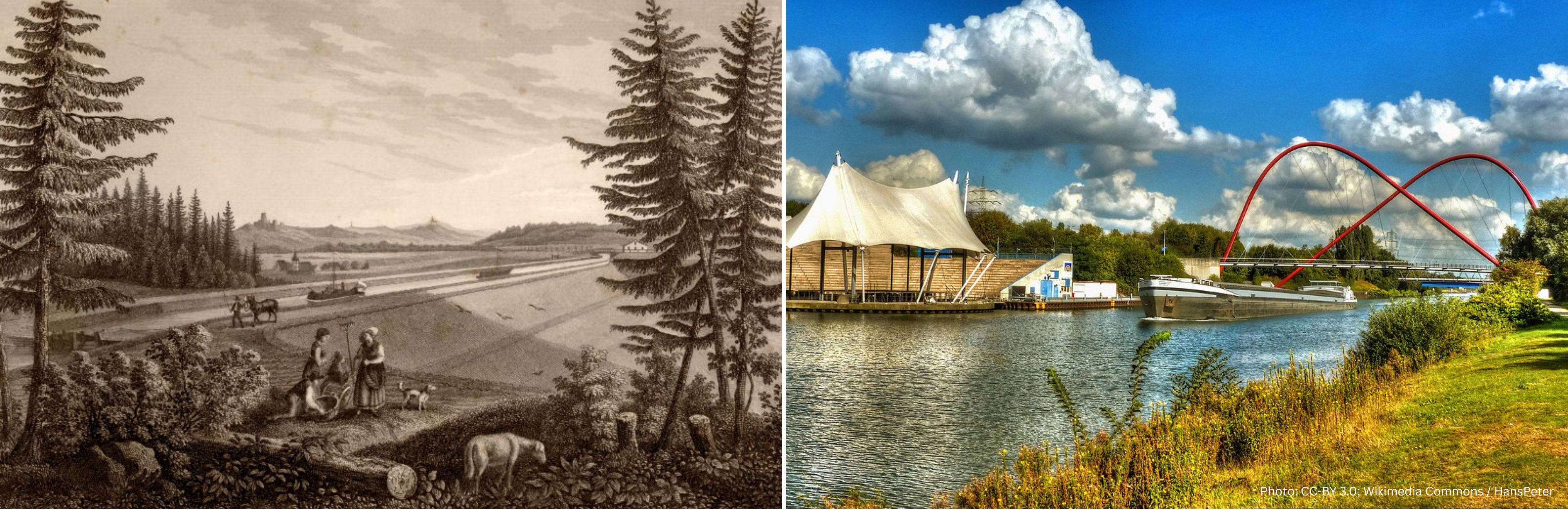
left: etching showing Ludwig Donau Main Canal, 1845 (CC0); right: photo of Rhein-Herne Canal in Gelsenkirchen (CC-BY 3.0, Wikimedia Commons / HansPeter)
©
left: etching showing Ludwig Donau Main Canal, 1845 (CC0); right: photo of Rhein-Herne Canal in Gelsenkirchen (CC-BY 3.0, Wikimedia Commons / HansPeter)
College for Social Sciences and Humanities (University Alliance Ruhr), Essen, Germany
Convenors: Ingo Heidbrink (Senior Fellow, College for Social Sciences and Humanities), Frank Uekötter (Ruhr University Bochum)
Shipping canals are an important feature of inland waterway navigation since late medieval times. Some canals still serve as important transport routes, others see little if any commercial traffic and plenty of pleasure boats, and some are defunct and barely visible in the landscape. At the same time, the canals that were actually built are just a fraction of those that were imagined and planned at some point in time. There is a great number of canal projects, some highly ambitious, that were proposed, discussed, and even partially constructed but failed to produce a complete, usable waterway.
Canal dreams were about more than transportation needs. They were often part of overarching schemes that sought to transform economies, create modern societies, and engage in nation-building. In hydrological terms, building canals could be an element in comprehensive plans that aimed for river regulation, independence from navigation in the open sea, or the redesign of entire river systems. Recent scholarship has explored how canals were a form of geo-engineering avant la lettre.
The workshop seeks to assemble an interdisciplinary group of researchers who have worked on the imagination, construction and operation of artificial inland waterways. It has a particular interest in contributions that explore the tension between dreams and hopes and built realities. Emphatically global in scope, the workshop departs from the assumption that canals have transnational features that provide windows on the material and imagined scaffolding of global modernity. Speakers may come from a variety of academic backgrounds including universities, research institutes, archives, and museums.
The concept of ‘Canal Dreams’ is open to a broad range of perspectives and approaches. Potential topics include, but are not limited to the following:
The workshop is organised by Ingo Heidbrink, Senior Fellow at the College for Social Sciences and Humanities of the University Alliance Ruhr (9/2025 – 2/2026), and Frank Uekötter, Chair of Technological and Environmental History at Ruhr University Bochum. Thanks to funding from the College for Social Sciences and Humanities, there will be no conference fee and the organisers will provide accommodation for all participants coming from outside the Rhine-Ruhr region.
Conference discussions will be based on pre-circulated papers that must be submitted at least a month before the event. The organisers intend to publish selected papers from the conference as an edited collection.
The deadline for proposal submission is 15 April 2026. Please submit an abstract of the proposed paper with up to 500 words including biographical information, contact details and institutional affiliation to events@college-uaruhr.de.
The organisers will send notifications of acceptance before the end of May 2026.
Latest update: 02/03/2026